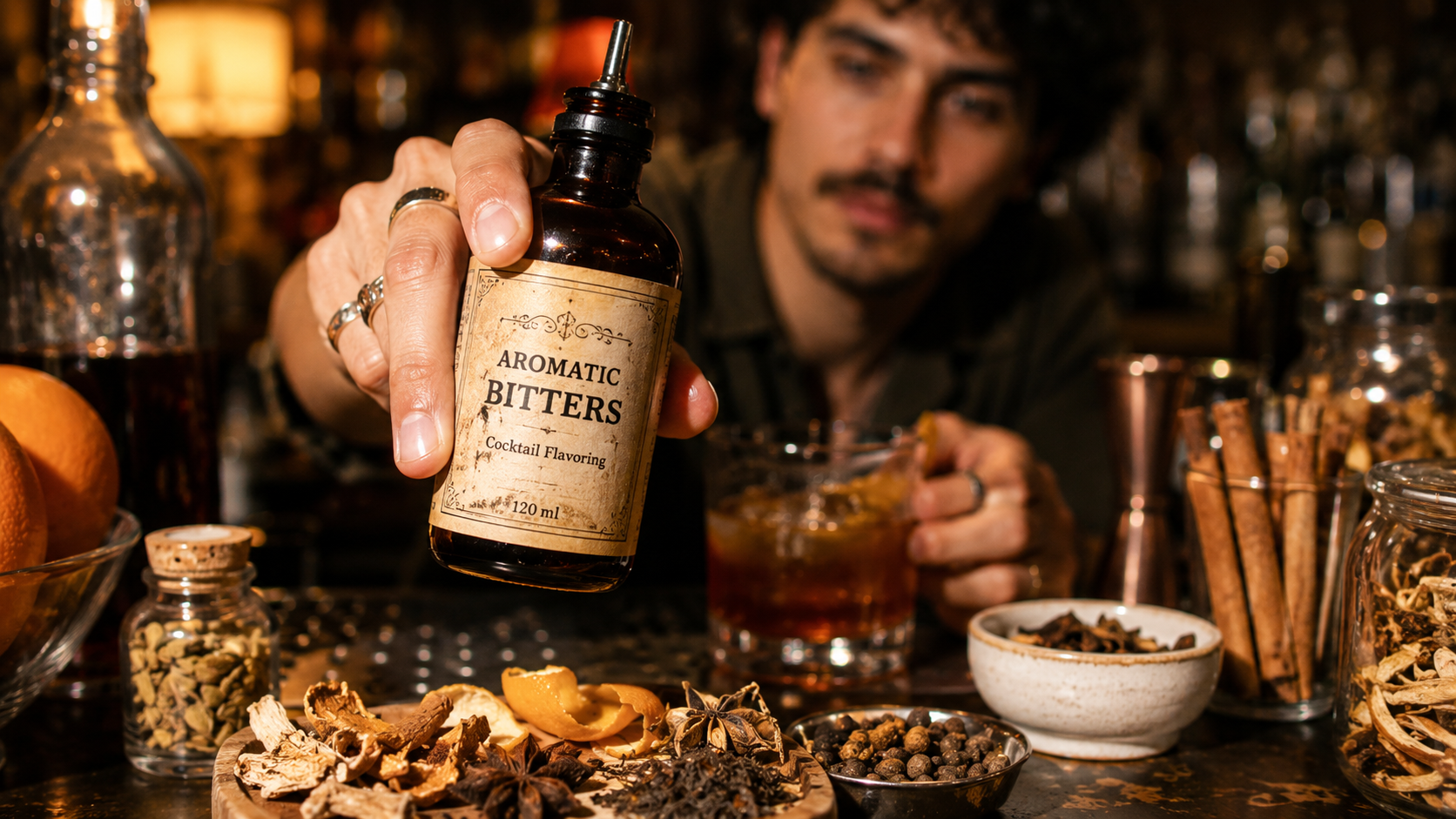
Bitters are a concentrated, high-proof flavoring made by steeping botanicals like roots, bark, and citrus peel in alcohol, then added to a drink a dash or two at a time to balance and round it out. Most home bars start with two styles, aromatic and orange, and a single bottle lasts through hundreds of drinks.
What are bitters, exactly?
Bitters are the seasoning of the cocktail world. A dash rounds out a drink the way a pinch of salt and a crack of pepper finish a dish, which is why plenty of bartenders call bitters the spice rack of the bar.
They're extremely concentrated and built on gentian, herbs, and spices, so you use them in tiny amounts as a flavoring rather than pour them like a spirit. You won't sip bitters on their own; they're a background ingredient working under the spirit and the sweetener to tie everything together.
The category name comes from that base bitterness, but a good bottle tastes more layered than plain bitter. Editors at Epicurious describe them as the ingredient that gives a cocktail depth and a finished edge.
That's the whole job. One or two dashes, stirred or shaken in, and the drink tastes finished instead of one-note.
What are bitters made of?
Bitters are botanicals steeped in high-proof alcohol, which pulls the flavor out and preserves the bottle at the same time. The alcohol acts as both the solvent and the preservative, and some modern brands swap in vegetable glycerin instead.
The botanicals and the base
Bittering agents are what give the category its name. Gentian root is the primary one in nearly every cocktail bitters brand, from Angostura to Regans' to Fee Brothers.
Wormwood, cinchona bark, and quassia bark are the other traditional bittering agents, each adding its own edge of sharpness. Makers pick and blend them to hit a signature flavor.
Around that base, makers layer aromatic and citrus notes. A typical bottle draws from botanicals like these:
- Gentian root, the main source of the bitterness
- Wormwood, cinchona, or quassia bark for backbone
- Citrus peel, usually orange, for brightness
- Warm spices such as cassia (a cinnamon relative), clove, and allspice
- Herbs and seeds like cardamom or anise, depending on the recipe
The exact blend is usually a trade secret, which is part of the fun.
Make your own
You can make your own bitters at home by steeping spices and peel in a neutral spirit for a few weeks, though it's a project rather than a quick fix. For most beginners, a couple of store-bought bottles cover everything you'll want to mix.
How do bitters work in a drink?
Bitters tie the sweet, the sour, and the strong parts of a drink together so it tastes balanced instead of flat. Without them, a spirit-and-sugar cocktail can read as either too sweet or too boozy, with nothing bridging the two.
The reason a tiny pour does so much comes down to concentration. Because bitters are so intense, a dash carries far more flavor per drop than the spirit does, which is why recipes call for drops instead of ounces.
That balancing role is old. When the word "cocktail" first appeared in print, in an 1806 newspaper called The Balance and Columbian Repository, the definition named bitters as one of only four ingredients.
"A stimulating liquor, composed of spirits of any kind, sugar, water, and bitters."
By that original 1806 definition, a drink without bitters wasn't even a cocktail, and you can taste why in the classics. A classic Old Fashioned is whiskey, sugar, and a few dashes of aromatic bitters, nothing more, while a stirred Manhattan leans on the same dashes to keep the vermouth and whiskey from turning cloying.
How much bitters should you use?
Start with one or two dashes, taste, then add more only if the drink needs it. A dash is an imprecise unit, so treat the number in a recipe as a starting point and let your palate finish the job.
In real terms, a dash lands somewhere around 0.6 to 1 milliliter, which one brand describes as a single squeeze of a dropper bulb. The Cocktail Society puts a dash near 0.92 ml, or about 6 to 10 drops.
Because that amount is far below 1 oz (30 ml), you're seasoning, not pouring. Two heavy-handed dashes can tip a delicate drink into medicine territory, so err light on your first try.
How to add a dash
The bottle does the measuring for you if you use it right, and we've tested this on our own home bars enough to trust the flick over any jigger:
- Hold the bottle upright and give it a gentle shake to settle the pour.
- Invert it fully over the glass, straight down.
- Give one sharp downward flick of the wrist. That's one dash.
- Taste the drink.
- Add a second dash only if it falls flat, then stop.
Once you're comfortable, you can start matching styles to drinks, like knowing which bitters to reach for in an Old Fashioned. When you're still second-guessing the pour, Garçon can walk you through the dash on any drink you're building.
The main types of bitters
Most home bars start with two styles, aromatic and orange, then branch out from there. The common types split neatly by flavor and by the drinks they were made for.
| Type | Flavor | Classic use |
|---|---|---|
| Aromatic | Warm spice, herbs, bark | Old Fashioned, Manhattan |
| Orange | Bright citrus zest | Gin drinks, whiskey sours |
| Peychaud's | Anise, cherry-red, floral | Sazerac |
| Celery | Savory, vegetal | Bloody Mary, gin fizz |
| Chocolate or mole | Cocoa, warm spice, chili | Tequila and mezcal drinks |
Aromatic bitters
Aromatic bitters are the default bottle, warm-spiced and herb-forward, with Angostura as the classic example. They're the dashes in an Old Fashioned or a Manhattan, and they lean on baking-spice and bark notes rather than fruit.
Angostura has a long backstory. A German surgeon, Dr. Johann Siegert, created the recipe in 1824 in the town of Angostura, Venezuela, first as a medicinal tonic; the brand marked its 200th anniversary in 2024 and still keeps the formula a trade secret.
If you buy one bottle first, make it an aromatic. It shows up in more recipes than any other style.
Orange bitters
Orange bitters are the brightest of the everyday styles, built on zesty citrus peel. They're the most popular citrus option and lift gin drinks, whiskey sours, and martinis with a clean, fragrant edge.
Think of orange bitters as the counterweight to aromatic. Where aromatic adds depth, orange adds sparkle.
A classic dry martini often calls for a single dash of orange bitters. That one addition is what separates a flat gin-and-vermouth pour from a bright, aromatic one, so it's the easiest place to taste what a citrus style brings.
Beyond the basics
Once you have the two staples, a few specialty styles are worth trying. Peychaud's, cherry-red and anise-forward, was created in 1838 by New Orleans apothecary Antoine Peychaud and is the soul of a Sazerac.
Celery bitters bring a savory, vegetal note to a Bloody Mary or a gin fizz. Chocolate and mole bitters, like the Bittermens Xocolatl Mole released in 2007, add cocoa and chili warmth to agave drinks.
The specialty shelf keeps growing, with smoke, coffee, and herbal blends all easy to find now. Treat these as flavor experiments once your two everyday bottles are earning their keep.
For a beginner, the answer to "which should I buy first" stays simple. One aromatic and one orange will cover the vast majority of whiskey cocktails and beyond, with the fun ones added later.
Once those two bottles are on the shelf, add them to My Bar and Garçon will show the drinks you can already build.
Can you use bitters without the alcohol?
Yes, glycerin-based bitters at 0.0% ABV work in the same dash amounts as traditional ones. They swap the alcohol base for a blend of glycerin and water, so you can season a mocktail or a low-proof drink the same way you would a full cocktail.
There's a small trade-off, since glycerin extracts flavor more slowly and tastes a touch sweeter, so you may need a little more to hit the same impact. One popular maker builds its zero-proof line from organic botanicals, water, glycerin, and a splash of apple cider vinegar.
This matters if you're mixing for someone who's cutting back or skipping alcohol entirely. Non-alcoholic bitters mean a zero-proof drink doesn't have to taste like flat juice, and keeping a bottle on hand makes it easy to pour something thoughtful for every guest.
Whatever you're mixing, drink responsibly and know that a good non-alc option is always a fair choice.
Bitters FAQ
What is the purpose of bitters?
The purpose of bitters is to season and balance a drink. A few dashes round out the sweet and the sour so the cocktail tastes finished rather than flat, the same way a seasoning brings a dish into focus.
They also add aroma and complexity you can't get from the spirit alone. That's why a drink with bitters smells and tastes layered instead of simple, and why leaving them out of an Old Fashioned makes it read like sweetened whiskey rather than a proper cocktail.
Can you drink bitters straight?
No, you shouldn't drink bitters straight. They're extremely concentrated and made to be used in drops or dashes, not sipped like a spirit.
A few dashes in soda water is a common no-alcohol-feel refresher, so a small culinary pour is fine. Bartenders sometimes reach for that trick to reset the palate between drinks.
Knocking back a full shot of bitters is a different story. It's not the idea, and at that concentration it won't taste good anyway.
Does bitters have alcohol in it?
Yes, traditional bitters are high-proof. Angostura, the best-known brand, is 44.7% ABV, which is stronger than most spirits.
The amount that reaches your glass is tiny, though. A single dash is well under 1 ml, so it adds a negligible amount of alcohol to a finished drink.
That concentration is also why the US classifies many bitters as a food flavoring rather than a beverage, which is how they end up on grocery shelves instead of behind the liquor counter.
Is drinking bitters good for you?
Bitters began as 19th-century patent medicines, sold as herbal stomachic tonics that promised to settle digestion before they ever became a bar staple. That medicinal past is where the "digestive bitters" idea comes from.
Modern cocktail bitters are a flavoring, not a health product, so enjoy them for taste and drink responsibly. The digestive-supplement angle is a different product and a topic for another day.
Do bitters expire, and are they worth buying?
Traditional bitters barely expire, because the high alcohol content self-preserves the bottle. At roughly 35 to 45% ABV, there's little for spoilage to grab onto.
Storage times vary by type, from decades down to a couple of years for the non-alcoholic bottles.
- Unopened: decades
- Opened: 5 to 10 years
- Glycerin or non-alcoholic versions: 1 to 2 years
That shelf life makes the math easy. A standard 4 oz (118 ml) bottle holds well over 100 dashes, so it lasts through hundreds of drinks and the cost per cocktail rounds to pennies.
So one bottle really is enough to start, and it won't go stale on you. You'll pour your way through an aromatic long before it ever has a chance to go off.
Your first pour with bitters
Your starter kit is two bottles, one aromatic and one orange, plus the one-to-two-dash, taste, adjust rule you now know. That combination unlocks the Old Fashioned, the Manhattan, and most of the whiskey classics worth knowing.
The best next step is to actually pour one. Try that classic Old Fashioned tonight and taste what a couple of dashes really do.
When you want to branch out, aromatized wines like vermouth are the natural next ingredient to learn. Add your bottles to My Bar and Garçon will build a shortlist of drinks you can make from exactly what's on your shelf.