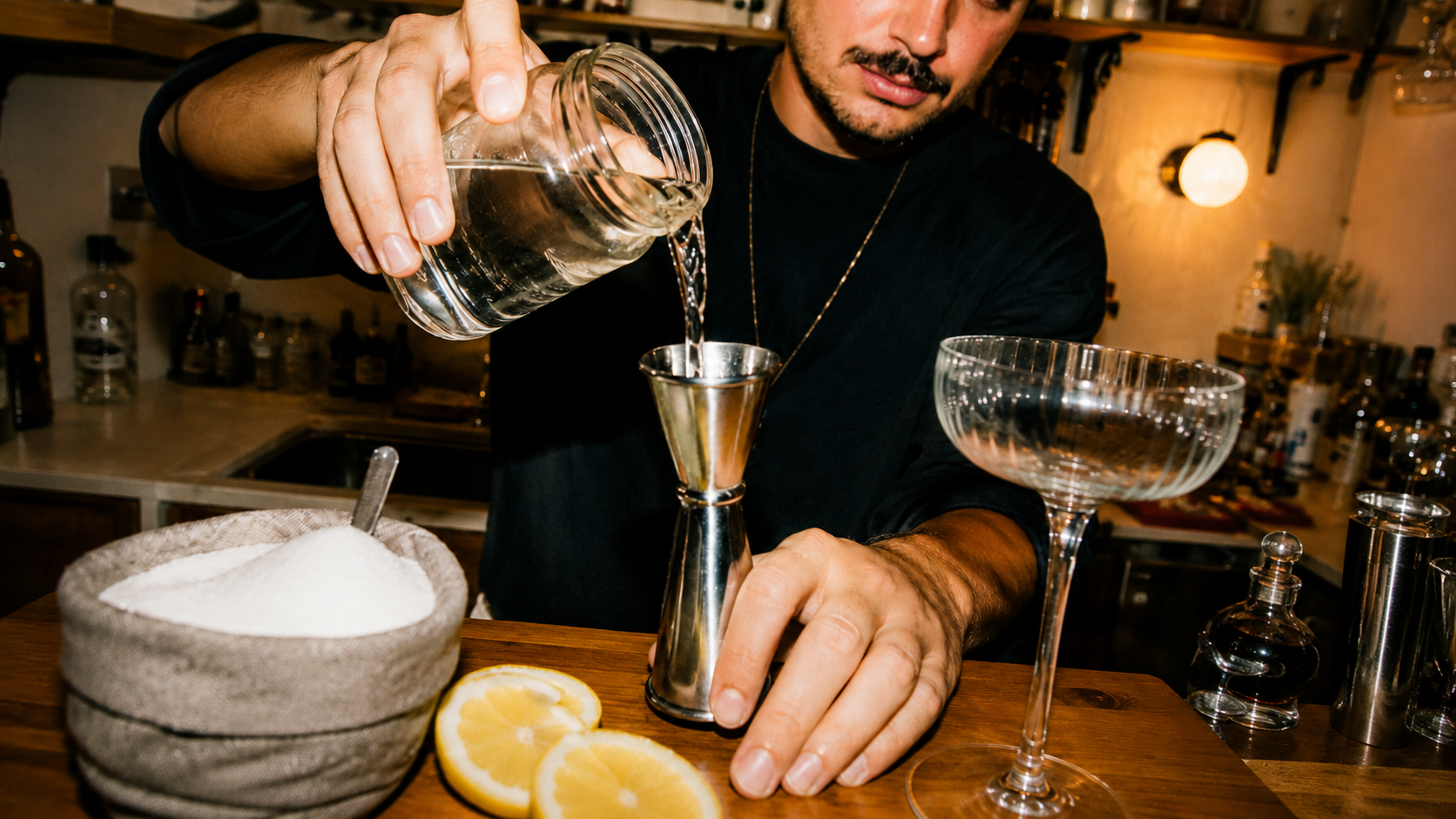
Simple syrup is equal parts sugar and water, stirred or warmed until the liquid turns clear. You can shake it together cold in a jar or dissolve it on the stove, and either way it's ready in minutes.
This guide covers the 1:1 and rich 2:1 ratios, both methods step by step, exact measures in ounces and milliliters, how much goes in each cocktail, and how to store what you make.
What is simple syrup, and what does it do in a drink?
Simple syrup is sugar dissolved in water, and it sweetens cocktails evenly because liquid sugar blends in instantly where granulated sugar would sink and sit gritty at the bottom.
That even blend is the whole point. A teaspoon of dry sugar never fully dissolves in a cold, shaken drink, so you taste sharp citrus on top and grainy sweetness underneath.
Syrup fixes that, and it gives you a reliable dial for balance. About 1 oz (30 ml) of 1:1 syrup roughly matches the tartness of 1 oz of citrus juice, which is what lets bartenders build the same balanced sour the same way every time.
1:1 vs rich 2:1: which simple syrup ratio to use
Use 1:1 for most cocktails and reach for rich 2:1 when you want more sweetness with less added water. The 1:1 ratio is the standard pour in American bars, so if you're following a US recipe, plain 1:1 is almost always what it means.
Rich 2:1 is the more common house syrup outside America. It has also gained ground with bartenders who want a spirit-forward drink to stay cold and strong, because a smaller pour of thicker syrup adds less water to the glass.
The catch that trips up most people is that 2:1 is not twice as sweet. Per Difford's Guide, 1:1 measures 48.0 Brix and 2:1 measures 65.1 Brix, which works out to about 1.35 times sweeter, a 35.6% jump rather than double.
| Ratio | Sugar : water | Sweetness | Best for | Keeps (fridge) |
|---|---|---|---|---|
| 1:1 (simple) | equal parts | 48.0 Brix; balances citrus 1:1 | most cocktails, sours, highballs | about 1 month |
| 2:1 (rich) | 2 parts sugar | 65.1 Brix; about 1.35x sweeter than 1:1 | spirit-forward drinks, less dilution | up to about 6 months |
To convert between them, Difford's puts 10 ml of 2:1 at about 15 ml of 1:1, and 20 ml of 2:1 at about 30 ml. Using 1:1 where a recipe asks for 2:1 adds roughly 5 to 8% more dilution, so reach for a touch more 1:1 to keep the sweetness in line.
How to make simple syrup: two methods
Both methods land you the same clear syrup. Pick by how fast you need it and which ratio you're making; the no-cook route suits a quick 1:1 batch, while gentle heat helps 2:1 dissolve fully.
No-cook method: stir or shake
Yes, you can skip the stove entirely for 1:1. Sugar dissolves in room-temperature water on its own; you're just speeding it along with movement.
- Add equal parts sugar and water to a clean jar with a tight lid.
- Seal it and shake hard for 2 to 3 minutes, or stir for 10 to 15 minutes if you'd rather not shake.
- Keep going until the liquid is completely clear with no grains visible at the bottom.
Superfine sugar dissolves fastest of all, so use it if you have it. Standard granulated sugar works too; it just wants a minute or two longer.
Plenty of beginners worry the sugar won't fully dissolve without heat. That worry is common, and the fix is simply more shaking time.
A cold-mixed batch tastes the same as a cooked one, with no caramel note from the stove.
Stovetop method: heat, don't boil
Heat the water until it's hot but not bubbling, add the sugar, and stir until it disappears. The Kitchn calls for warm water rather than a rolling boil, and that gentler heat is the trick.
Your syrup is finished the moment the sugar dissolves, which takes about 3 to 5 minutes of gentle heat. Pull the pan off and let it cool before bottling.
Rich 2:1 is the one case where heat earns its keep, because that much sugar dissolves slowly in cold water. Warm it gently and stir, and the extra sugar goes into solution in a couple of minutes, which is the main reason to reach for the stove over the jar.
Exact measures: how much sugar and water
Start with a small batch you'll actually use. A cup of sugar makes plenty of syrup for a weekend of drinks without going to waste before it spoils.
A standard 1:1 batch is one cup of sugar to one cup of water, while a rich 2:1 doubles the sugar to two cups against the same one cup of water. Scale either up or down in even multiples to keep the ratio honest.
| Ratio | Sugar | Water | Yields (approx) |
|---|---|---|---|
| 1:1 | 8 oz (240 ml) / 1 cup | 8 oz (240 ml) / 1 cup | about 12 oz (355 ml) |
| 2:1 | 16 oz (475 ml) / 2 cups | 8 oz (240 ml) / 1 cup | about 14 oz (415 ml) |
Weight vs volume, and why it matters
Weigh your ingredients if you want a true ratio. A cup of granulated sugar weighs about 200 g while a cup of water weighs about 240 g, so "equal parts by volume" actually comes out closer to 0.85:1 sugar to water by weight.
For most home drinks that small gap won't change your cocktail, so measuring cups are fine to start. A kitchen scale matters more for 2:1, where precise amounts help you hit the higher concentration cleanly.
The reason heat helps that richer batch comes down to chemistry. Water holds about 204 g of sugar per 100 g at room temperature, rising to roughly 487 g near boiling, so warming the water lets it take on the extra sugar a 2:1 ratio needs.
How to use simple syrup in cocktails
Most shaken sours take about 0.5 to 1 oz (15 to 30 ml) of 1:1 syrup, then you taste and adjust from there. Treat the amounts below as starting points rather than strict rules, and trust your own palate once you've made a drink twice.
Citrus-heavy drinks lean on more syrup to balance the tartness, while a spirit-forward build like an old fashioned needs only a barspoon or two so the whiskey stays in front.
| Drink | Simple syrup (1:1) |
|---|---|
| Daiquiri | about 0.5 to 0.75 oz (15 to 22 ml) |
| Mojito | about 1 oz (30 ml) |
| Old fashioned | about 1 to 2 tsp (1/6 to 1/3 oz) |
Those pours scale straight into a classic daiquiri, a mojito, and simple syrup in an old fashioned. The same syrup sweetens zero-proof and low-ABV builds just as well, so a mocktail or a session highball gets the same balanced finish without the alcohol.
Once you have that jar ready, add the bottles you already own to My Bar and Garçon will point you to the drinks on this list you can build tonight. Tell Fix Me a Drink what's in your cabinet and it builds the shortlist for you, including mint-forward cocktails that lean on that mojito syrup.
Common simple syrup mistakes and how to avoid them
The two failures you'll run into are crystallization and a cooked, faintly burnt taste. Both are easy to dodge once you know they almost always trace back to too much heat or undissolved sugar.
- Don't boil it. Boiling drives off water and shifts your ratio, can caramelize the syrup into an off color and flavor, and past about 220°F pushes it into supersaturation that crystallizes later.
- Stir or shake until fully clear. Leftover sugar granules act as seeds that grow into crystals in the jar.
- Leave it alone as it cools. Stirring a cooling batch can knock sugar out of solution.
- Store it airtight. An open container invites moisture swings and contamination.
Get those four habits right. Your syrup will pour clear and taste clean every single time.
How long does simple syrup last?
A 1:1 syrup keeps about a month in the fridge in an airtight container. Rich 2:1 keeps up to about six months, because the higher sugar concentration lowers water activity and leaves less free water for mold and bacteria to use.
Toss any batch that turns cloudy or smells off, since those are signs of spoilage. Stirring in about 1 tbsp of vodka stretches a 1:1 syrup toward three months by raising the alcohol content.
Either way, a clean, sealed jar and a spot in the back of the fridge buy you the most time. Label the jar with the date you made it so you are never guessing how old a batch is.
Flavored and infused variations
Once plain syrup is second nature, the same 1:1 base happily takes on flavor. Herbs, citrus peel, vanilla, and warm spices all work.
Drop them in while the syrup is warm for a fast infusion, or steep them cold for a day in the fridge for a cleaner, brighter result. A few mint sprigs or a strip of lemon peel is enough to turn a plain batch into something built for a specific drink.
Taste as you go and strain out the solids once the flavor reads the way you want, since a peel or herb left in too long can turn bitter.
Frequently asked questions
Do you have to boil simple syrup?
No. The sugar only needs to dissolve, which happens with gentle heat or no heat at all for 1:1, and boiling changes the ratio while risking a cooked taste.
Is rich (2:1) simple syrup twice as sweet?
No. Rich 2:1 is about 1.35 times sweeter than 1:1, not double, per Difford's Guide.
Should you measure simple syrup by weight or by volume?
Weigh it for accuracy. Equal parts by volume comes out closer to 0.85:1 by weight, because sugar and water have different densities.
Can you freeze simple syrup?
Yes. The dissolved sugar lowers the freezing point, so it firms up rather than freezing solid. Pour it into an ice cube tray for portioned servings, leave a little headroom for expansion, then thaw what you need in the fridge.
Why is my simple syrup cloudy or crystallized?
Cloudiness or an off smell means it's spoiled, so pour that batch out and make a fresh one. Grainy crystals are a different problem and trace back to sugar that never fully dissolved.
Your next pour with homemade simple syrup
A jar of 1:1 in the fridge is enough to build most classic cocktails tonight, from a quick daiquiri to an old fashioned. Once your syrup's ready, browse cocktails by spirit and occasion and put it to work.