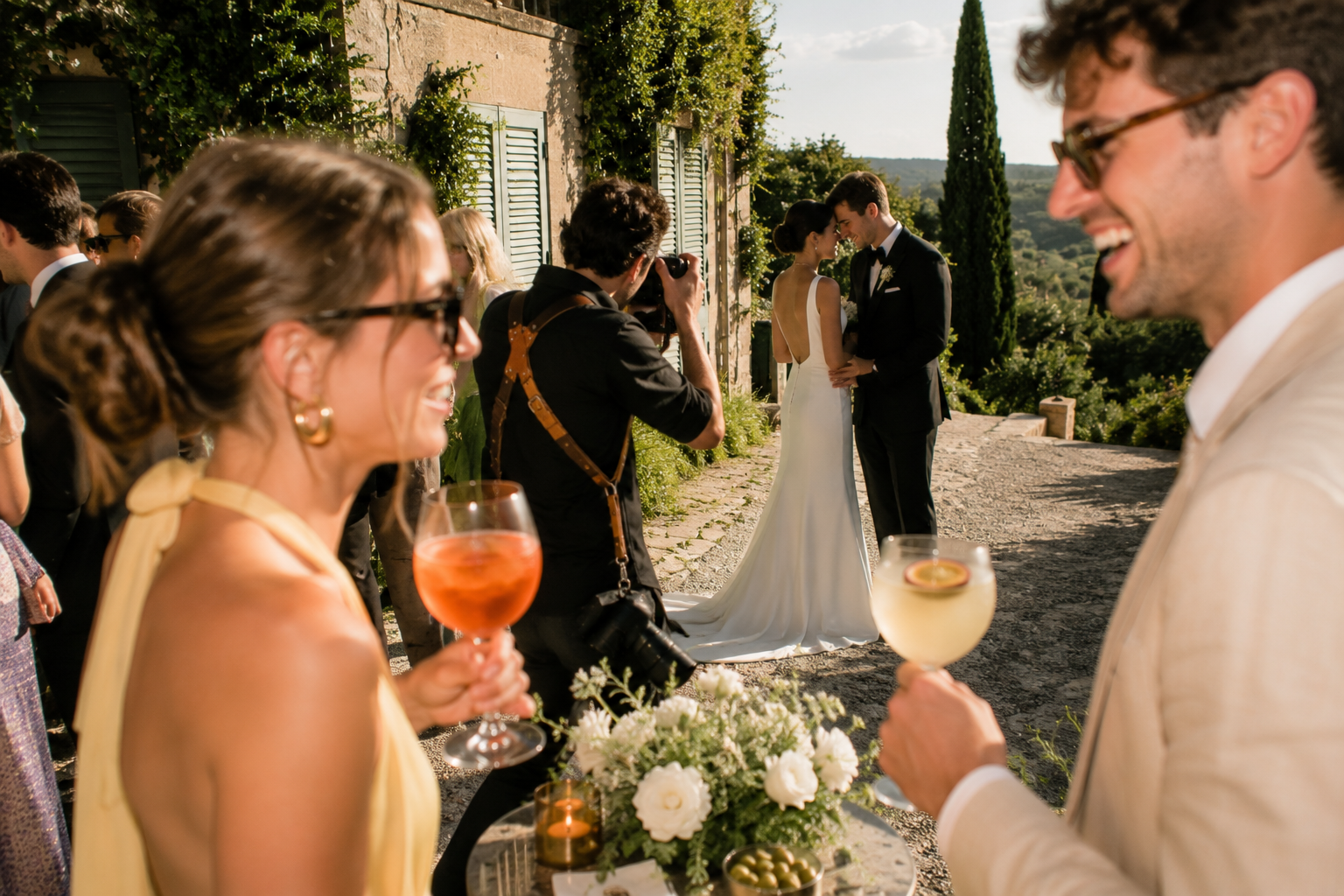
Cocktail hour at a wedding runs 60 minutes in most cases. You can stretch it to 75 or 90 minutes when photos run long or the venue needs more time to reset.
Past 90 minutes, guests get restless, hungry, or over-served. That makes 90 the practical ceiling for nearly every wedding.
How long should cocktail hour be?
One hour is the standard, and 90 minutes is the practical ceiling. The Knot describes a wedding cocktail hour as "just like it sounds, one hour," extendable to 75 or 90 minutes when you need the extra time.
Wedding Spot puts the same hour at the center, with up to 90 minutes acceptable and two hours pushing it.
Length falls into three tiers, each with a clear use:
- 30 minutes is a tight window for a small guest list and a fast room flip.
- 60 minutes covers most weddings without leaving anyone standing around.
- 90 minutes buys breathing room when the couple skips a first look or the venue sits far from the ceremony site.
| Cocktail hour length | When it works | Watch-out |
|---|---|---|
| 30 minutes | Single space, fast room flip, small guest count | Feels rushed; not enough time to serve everyone a drink |
| 60 minutes | Standard; photos with a first look; most weddings | None, the safe default |
| 90 minutes | No first look, large guest list, venue travel | Guests get restless past about 45 minutes without food or stations |
Treat these as planning defaults, not rules. Every wedding moves on its own clock, so use your photo plan, venue, and guest count to nudge the number up or down from the 60-minute baseline.
When does cocktail hour happen in the wedding timeline?
Cocktail hour almost always runs right after the ceremony, while the couple finishes photos and the venue resets for dinner. A typical start time is late afternoon, around 4 or 5 p.m., bridging the gap before the reception begins.
What time is cocktail hour, and where does it fit?
Cocktail hour starts the moment the ceremony ends and guests move from their seats to the bar. The Knot describes it as the breather between the ceremony and the reception, the stretch where guests grab a drink while the main room gets turned over.
The order is steady from wedding to wedding:
- Ceremony ends
- Cocktail hour begins
- Couple finishes portraits
- Grand entrance
- Dinner and reception
This hour also absorbs travel time when the ceremony and reception sit at different addresses. Rather than leaving guests with an awkward gap, you give them a drink, a bite, and somewhere to mingle while everyone relocates.
Is cocktail hour before or after the ceremony?
After the ceremony, in nearly all US weddings. The Knot notes that cocktail hour lands after the ceremony as a breather, though some cultures and couples hold a version of it beforehand.
A pre-ceremony cocktail hour works when you want guests relaxed and settled before they sit down. It can also fill a long arrival window when people show up well ahead of the start time.
The trade-off is real. Some guests would rather not drink before sitting through a ceremony, so the after-ceremony slot stays the default.
Zola's guide to the power of the happy hour treats the post-ceremony window as the standard for the same reason. It gives guests a natural reward and gives you a buffer.
What happens during cocktail hour?
Guests mingle, drink, and snack while the couple finishes portraits and the venue turns over for dinner. For many guests it is the first real chance to mix before everyone sits down to eat.
For guests, the hour fills up fast:
- Drinks from the bar or a signature cocktail station
- Passed appetizers or a grazing table
- Light music from a duo or a playlist
- Mingling, photos, and finding their seating cards
The couple is absent for much of it, off shooting portraits with the photographer. Push cocktail hour past an hour and you need a reason for guests to stay engaged.
Wedding Spot suggests interactive features like an oyster bar or a caricature artist to hold attention when the window runs long.

What changes how long cocktail hour should be?
Your photo plan, the venue layout, and your guest count are the three things that move the dial. Each one can pull the hour shorter or push it toward 90 minutes, so weigh all three before you lock the number.
Photos and the first-look decision
Skipping a first look is the single biggest reason to extend cocktail hour. With a first look, the photographer can finish roughly 90% of portraits, about 45 minutes of shooting, before the ceremony, which frees the couple to join cocktail hour and makes 60 minutes plenty.
Without a first look, the couple typically spends the whole hour on post-ceremony portraits. The Knot specifically flags this as the moment to extend cocktail hour, pushing toward 75 or 90 minutes so the photos do not eat into dinner.
Venue flip and single-room logistics
If the ceremony and reception share one room, cocktail hour has to cover the flip. Your team needs time to clear ceremony chairs, set tables, and reset the space, and 60 minutes is the realistic minimum for that turnaround.
Travel between two venues works the same way. Wedding Spot lists travel time and venue transitions among the factors that stretch the hour.
If the flip routinely runs over, plan for 90 minutes and add a station so guests are not just waiting.
Guest count and the meal gap
Bigger guest lists need more time to get everyone served and seated. The average US wedding hit 117 guests in 2025, and a crowd that size takes longer to move through a bar than a 50-person celebration.
Extending the hour is not free. Wedding Spot points out that a longer cocktail hour raises costs for alcohol, food, rental time, and staff labor, so weigh the extra 30 minutes against the budget before you commit.
Caterer and bartender availability matter too. Wedding Spot lists staff schedules among the practical limits on length, so confirm your vendors can cover a 90-minute window before you plan for one.
A bigger crowd also wants more bartenders. One server cannot keep 117 guests in drinks during a short window.
Signs your cocktail hour is too long or too short
Under 30 minutes feels rushed, and past 90 minutes guests get bored, hungry, or over-served. The tells on each side are easy to spot once you know what to watch for.
A cocktail hour that runs too short shows up as a line at the bar, guests still holding empty hands when dinner is called, and a couple who walk in mid-portrait while the reception is meant to start. The fix is to add 15 to 30 minutes and let the room breathe.
A cocktail hour that runs too long has its own warning signs. Wedding Spot notes that guests start to get restless after about 45 minutes, and a long open bar with no food invites over-serving before dinner.
| Too short | Too long |
|---|---|
| Bar lines, no buffer | Restless guests after 45 min |
| Couple still shooting at "start" | Over-serving before dinner |
| Fix: add 15 to 30 minutes | Fix: add food stations or trim to 60 min |
How many drinks to plan for cocktail hour
Plan about two drinks per guest for a 60-minute cocktail hour, then one more drink per guest for each additional hour. People drink faster early in the night and slow down as dinner approaches, so the front of the evening carries the heaviest pour.
The 60- vs 90-minute drink math
Two drinks per guest covers a standard 60-minute hour, and you add one more per guest to reach 90 minutes. The Knot's bar guidance works out to roughly one drink per guest per hour, about five across a full five-hour reception.
The cocktail-hour stretch runs heavier than the rest of the night because guests arrive thirsty.
Scale it to your headcount. For a 117-guest wedding, a 60-minute hour means roughly 234 drinks, and a 90-minute hour pushes that toward 350.
Split the stock close to the standard mix The Knot recommends, around 50% liquor, 25% beer, and 25% wine, then adjust for your crowd.
These are planning estimates, not exact counts. Once you know your length and headcount, Fix Me a Drink lets you add your bottles to My Bar and ask Garçon to scale quantities and show the cocktails you can already make from what you own.

| Guests | 60-minute hour (≈2/guest) | 90-minute hour (≈3/guest) |
|---|---|---|
| 50 | 100 drinks | 150 drinks |
| 100 | 200 drinks | 300 drinks |
| 117 | 234 drinks | 351 drinks |
Signature cocktails that suit a short window
Batchable, low-fuss drinks win a 60-minute window. A two-ingredient signature or a pre-batched pitcher moves guests through the bar far faster than a build that needs shaking to order, which keeps the line short and the energy high.
Pick one spirit-forward option and one lighter pour, and include a low-ABV or zero-proof choice so every guest has something to hold. If you want signature cocktail ideas for your guests, the recipe collections are a quick way to find drinks that batch well and read well on a sign.
Cocktail hour FAQs
What time does cocktail hour start?
Cocktail hour starts in the late afternoon, right after the ceremony ends, around 4 or 5 p.m. for most weddings. The exact clock time follows your ceremony, since cocktail hour bridges the gap to the reception rather than running on a fixed schedule.
Is cocktail hour before or after the ceremony?
After the ceremony, in nearly all US weddings. The Knot frames it as a breather between the ceremony and the reception, so guests grab a drink while the couple shoots portraits and the venue resets.
Is a 30-minute cocktail hour too short?
For most weddings, yes. Thirty minutes leaves little room to serve everyone a drink and reset the room, so it only works for a small guest list with a fast flip and no first-look photos to finish.
Is a 90-minute cocktail hour too long?
Not if you give guests something to do. With food stations or no first look, 90 minutes works well, and Wedding Spot treats it as the upper edge of acceptable before guests lose patience.
Are two hours too long for cocktail hour?
For most weddings, yes. Two hours tends to bore guests, leave them hungry, and invite over-serving before dinner, so 90 minutes is the practical limit unless you have a clear reason and a plan to fill it.
How many drinks should I plan per guest for cocktail hour?
About two drinks per guest for the first hour, then one more per guest for each additional hour. People drink faster early in the evening, so the cocktail-hour stretch carries a heavier pour than the rest of the night.
Plan your cocktail hour bar with confidence
Sixty minutes is your default, and 90 is the ceiling you reach for only when photos, a venue flip, or a big guest list demand it. Lock the length first, because everything downstream, from the drink count to the bar mix, scales off that one number.
Once the length is set, sizing the bar is the next step. Run your headcount and the two-drinks-per-guest baseline, then let Garçon do the math on quantities and recipes from the bottles you already plan to pour.